
Non-Conveyance Decisions for Student Paramedics: How to Make Safe and Defensible Choices
Non-conveyance is one of the highest-risk decisions you will make
For many student paramedics, non-conveyance is where confidence drops sharply.
It feels safer to transport every patient.
It feels riskier to leave someone at home.
And yet, in modern UK paramedic practice, non-conveyance is common, appropriate, and expected when done safely.
This creates a difficult tension:
You must make decisions with real consequences, often with incomplete certainty.
This guide explains how to approach non-conveyance decisions from a clinical reasoning and defensibility perspective, not guesswork.
What non-conveyance actually means
Non-conveyance is not simply “not taking a patient to hospital”.
It is a clinical decision that:
The patient does not currently require hospital-based care
Risks have been assessed and deemed acceptable
Appropriate safety-netting has been provided
This decision must always be:
Clinically justified
Documented clearly
Defensible if reviewed later
Why student paramedics struggle with non-conveyance
From an educational perspective, difficulty arises because:
Students are trained to identify illness, not always to rule out risk
Fear of negative outcomes outweighs understanding of safe thresholds
Decision-making responsibility feels new and high-stakes
Students often think:
“What if I miss something?”
“What if they deteriorate later?”
These are valid concerns — but avoiding decisions is not the solution.
The principle of defensibility in non-conveyance
A safe non-conveyance decision is one that you can clearly explain:
What you found
What you considered
What you ruled out
Why hospital care was not required
📌 If you cannot explain your reasoning, the decision is not defensible.
Importantly:
A defensible decision can still have a poor outcome
An indefensible decision can appear to have a good outcome
It is the reasoning, not the result, that is judged.
A structured approach to non-conveyance decisions
1. Confirm clinical stability
Before considering non-conveyance, ask:
Is the patient physiologically stable?
Are observations within acceptable limits?
Is there any sign of deterioration?
Instability should always lower your threshold for conveyance.
2. Identify red flags (and actively look for them)
Do not assume absence of risk — actively seek it.
Consider:
Serious causes of the presenting complaint
Atypical presentations
Vulnerable patient groups
📌 Non-conveyance requires ruling out risk, not just identifying normality.
3. Consider the patient’s context
A patient’s environment and circumstances matter:
Can they self-care?
Do they have support at home?
Can they access follow-up care?
Are there safeguarding concerns?
A clinically “well” patient may still be unsafe to leave.
4. Evaluate uncertainty
You will rarely be 100% certain.
Ask yourself:
What is the worst-case scenario?
How likely is it?
What would I do if I were wrong?
If uncertainty is high and risk is significant, conveyance is often the safer option.
5. Provide clear safety-netting
Safety-netting is not optional — it is essential.
Patients should understand:
What to expect
What warning signs to look for
When and how to seek further help
📌 Poor safety-netting is a common cause of unsafe non-conveyance.
Non-conveyance in OSCEs vs real practice
OSCE context:
Conservative decisions are rewarded
Verbalising reasoning is essential
Safety-netting must be explicit
Clinical context:
Decisions are more nuanced
Documentation becomes critical
Shared decision-making with other healthcare professionals and the patient is key
Students should not equate OSCE performance with real-world thresholds — they are intentionally more cautious.
Common non-conveyance errors seen in students
From a supervisory perspective, common issues include:
Deciding too early (before full assessment)
Failing to consider worst-case scenarios
Inadequate documentation of reasoning
Weak or absent safety-netting
Being reassured by normal observations alone
These errors are predictable — and preventable with structured thinking.
Documentation: where your decision is truly judged
In non-conveyance, documentation is not an afterthought — it is your primary defence.
Good documentation should clearly show:
Assessment findings
Clinical reasoning
Risk consideration
Patient understanding and agreement
📌 If it is not documented, it cannot be defended.
Final clinical perspective
Non-conveyance is not about being confident enough to leave a patient at home.
It is about being clinically justified in doing so.
As a student paramedic, your goal is not to make bold decisions — it is to make:
Safe decisions
Thoughtful decisions
Defensible decisions
Confidence comes later.
Good judgement comes first.
Supporting safe non-conveyance decisions
PocketClinician resources are designed to support structured assessment, risk-based decision-making, and clear documentation, helping student paramedics make safer decisions both in OSCEs and on placement.
Use tools that strengthen your reasoning — not just your recall.
Take a look at the history taking question guide. A bank of questions that will assist you in ruling out your differentials, enabling you to increase the safety of your non-conveyances.
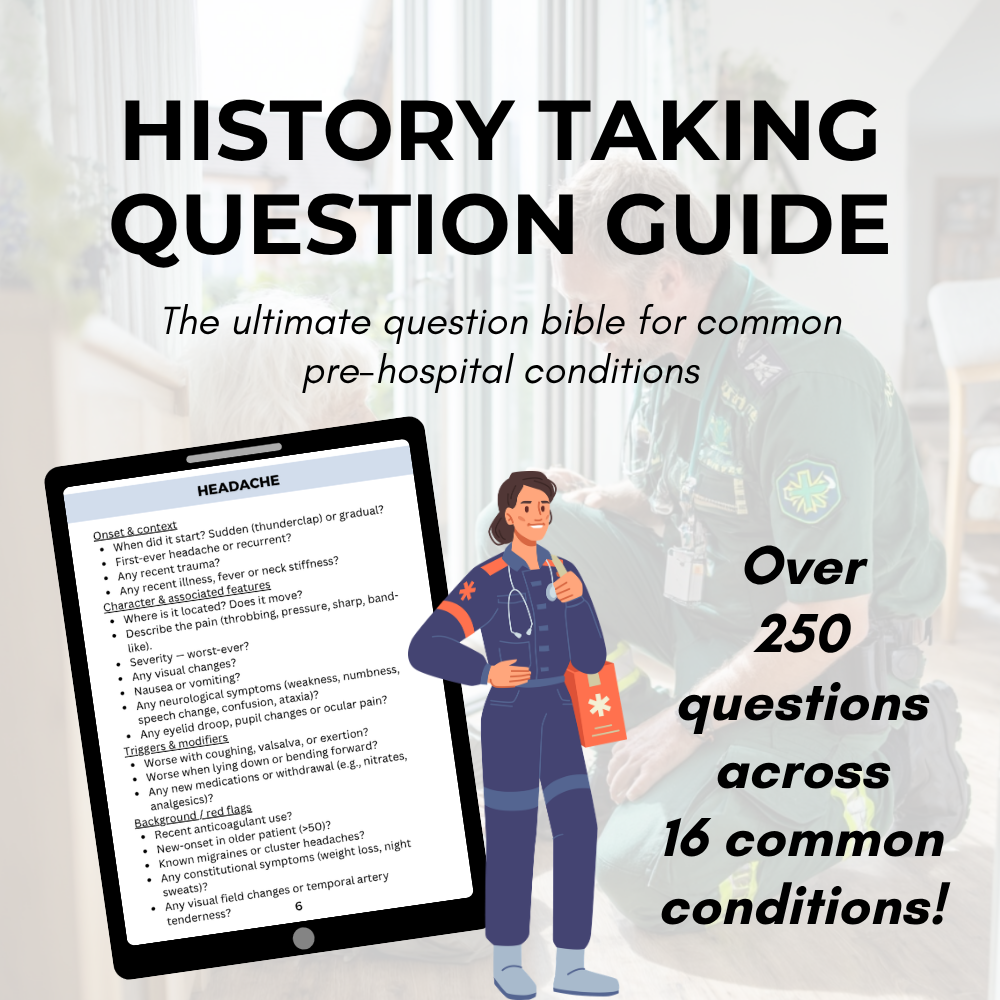
The Ultimate History Taking Question Guide for Student Paramedics & Ambulance Clinicians
Mastering patient assessment is one of the most challenging skills in pre-hospital care — but now you’ll never forget what to ask again. The History Taking Question Guide is your clinical companion, designed specifically for student paramedics, newly-qualified paramedics, and ambulance clinicians who want to feel confident, competent and structured on every job.
Packed with over 250 targeted, condition-specific questions, this book helps you rapidly build a full, accurate patient history, rule in and rule out key differential diagnoses, and improve your on-scene decision-making. Whether you’re preparing for OSCEs, working through placements, or responding to real 999 calls, this guide gives you the exact prompts you need — right when your mind goes blank.
Developed by a registered paramedic with frontline experience and teaching expertise, this is the same system used to help thousands of learners improve their assessment skills and clinical reasoning.
What’s Inside
Highly structured history-taking questions for 15+ common pre-hospital presentations
Covers cardiac arrest, chest pain, seizures, shortness of breath, syncope, headaches, trauma, obstetrics & gynaecology, diabetic emergencies, mental health, abdominal pain and more
Designed for quick reference en route to a job or during revision
Ideal for student paramedics, NQPs, EMTs, ECA/ACAs, and anyone preparing for paramedic OSCEs or university assessments
Clear, concise, easy-to-use format
Helps you form strong differential diagnoses and improves clinical confidence
Why Student Paramedics Love It
Boosts confidence on placement
Improves OSCE performance
Reduces “mind blanks” under pressure
Great for tutors, mentors and practice educators
Supports safe, structured paramedic assessments
If you want to feel more prepared on every job, communicate better during handovers, and think like a clinician, this is the essential pocketbook every student paramedic should carry.