
Paramedic Handover: How to Communicate Like a Professional Clinician
Handover is not a summary. It is a clinical intervention
For many student paramedics, handover is treated as the final step of a job, something to “get through” once assessment and treatment are complete.
In reality, handover is a critical point of patient care.
It is the moment where:
Responsibility transfers
Clinical information is condensed
Risk must be communicated clearly
A poor handover can:
Delay treatment
Omit critical information
Increase patient risk
A good handover, by contrast, ensures continuity, clarity, and safety.
Handover is not communication for convenience. It is communication for patient safety.
What handover is designed to achieve
A clinically effective handover should allow the receiving clinician to immediately understand:
What is wrong with the patient
How unwell they are
What has been done so far
What needs to happen next
If your handover does not achieve these four things, it is incomplete, regardless of how structured it sounds.
Why student paramedics struggle with handover
From an educational perspective, difficulties usually arise because:
Students focus on including everything, rather than prioritising relevance
Handover is practised in isolation, not as part of assessment
Anxiety leads to rushed or disorganised communication
This often results in:
Long, unfocused handovers
Missing key risk information
Poor clinical impression
📌 Handover is not about saying more. It is about saying what matters.
Structure matters, but only if you understand it
Frameworks such as SBAR (Situation, Background, Assessment, Recommendation) are widely taught.
However, structure alone does not create quality.
SBAR only works if:
You understand what is clinically important
You prioritise risk
You avoid unnecessary detail
A structured but poorly prioritised handover is still unsafe.
What a high-quality paramedic handover sounds like
A professional handover should be:
Clear — easy to follow
Concise — no unnecessary detail
Clinically focused — prioritising risk and findings
Confident — without sounding uncertain or vague
Example (simplified structure):
Patient identification and presenting problem
Relevant history and key findings
Clinical impression
Interventions and response
Current status and concerns
📌 The most important part is not the structure, it is the clinical story you are telling.
Clinical impression: the most important (and most avoided) element
Many students hesitate to state a clinical impression.
They worry about being wrong.
However, in practice:
A missing clinical impression is more problematic than an imperfect one.
Your impression shows:
Clinical reasoning
Prioritisation
Understanding of the case
Without it, the receiving clinician must reconstruct your assessment from scratch.
Common handover mistakes seen in students
From a teaching and supervisory perspective, the most frequent issues include:
1. Information overload
Including every detail dilutes important information.
2. Missing key risk factors
Failing to highlight red flags or concerns.
3. Lack of structure under pressure
Nerves lead to disorganised communication.
4. No clear clinical impression
Describing findings without interpretation.
5. Weak or absent recommendation
Not stating what you think should happen next.
Handover in OSCEs vs real practice
OSCE context:
Structure is heavily assessed
Verbal clarity is essential
Clinical reasoning must be explicit
Clinical context:
Communication is more conversational
Time pressure is real
Interruptions are common
Students should be prepared to adapt while maintaining clarity and prioritisation.
Why handover starts during assessment, not at the end
One of the most important shifts in thinking is this:
Handover is not prepared at the end — it is built throughout the job.
As you assess the patient, you should be forming:
A clinical narrative
A prioritised summary
A clear impression
This makes handover:
Faster
More coherent
More confident
Documentation and handover are closely linked
Your handover and your documentation should align.
Both should reflect:
What you found
What you thought
What you did
Why you did it
If your handover and documentation tell different stories, your clinical reasoning becomes difficult to defend.
Final clinical perspective
Handover is one of the clearest reflections of your development as a clinician.
It demonstrates:
Your ability to prioritise
Your understanding of risk
Your clinical reasoning
Your professionalism
As a student paramedic, you do not need to deliver perfect handovers.
You need to deliver:
Clear handovers
Safe handovers
Thoughtful handovers
Everything else improves with experience.
Supporting professional communication and handover
PocketClinician resources are designed to support structured communication, clinical reasoning, and clear documentation, helping student paramedics develop confidence in handover during both OSCEs and real-world practice.
Use tools that support clarity, not complexity.
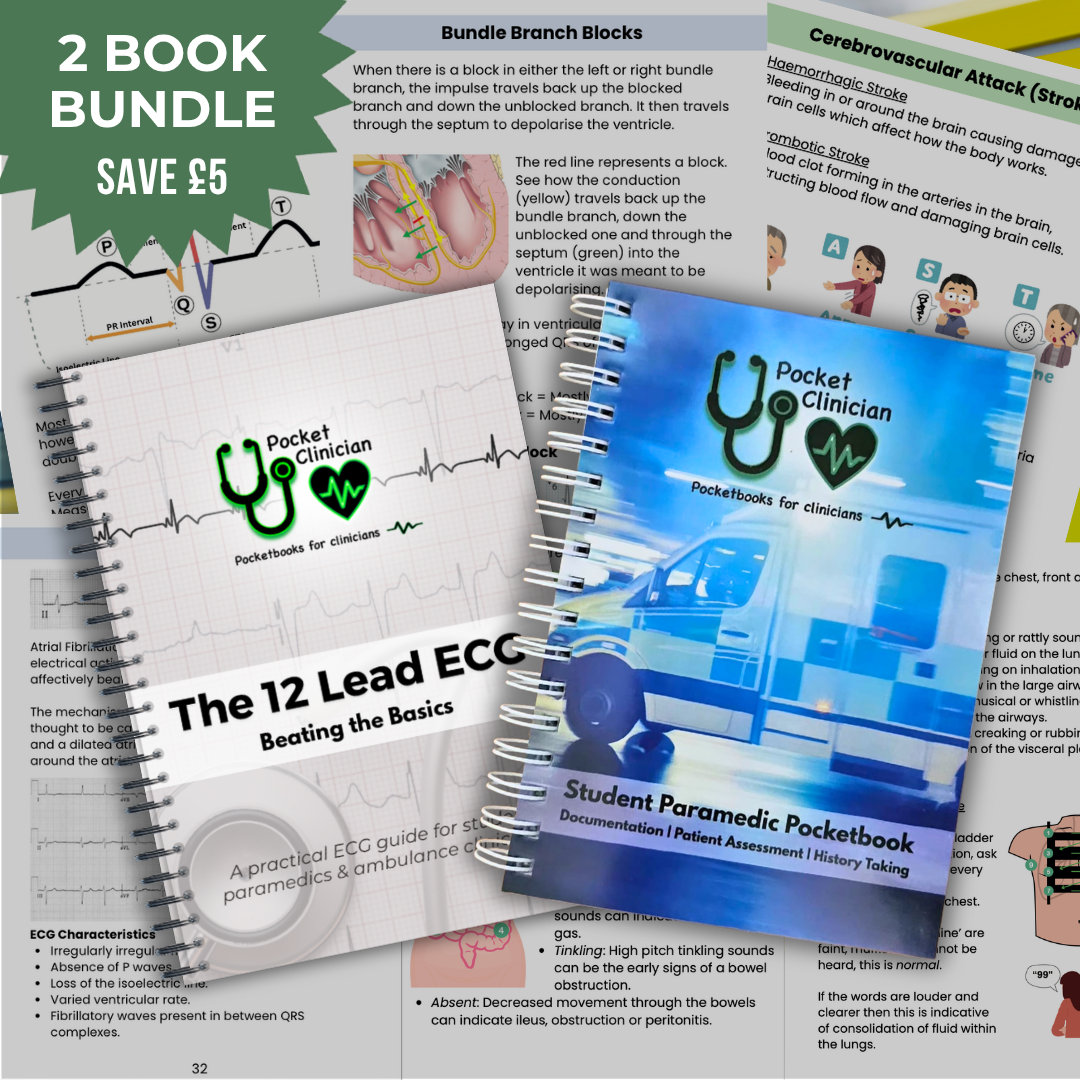
Two essential pocketbooks for confident patient assessment, documentation & 12-lead ECG interpretation
Built for student paramedics. Trusted by ambulance clinicians.
The Student Paramedic Bundle is a practical, on-shift reference designed to support UK student paramedics and ambulance clinicians with the skills that matter most: patient assessment, professional documentation, clinical handover, and ECG interpretation.
This bundle includes two pocket-sized guides that work together to build confidence on placement, in OSCEs, and on the road — without unnecessary theory or overwhelming detail.
At a glance
✔ Updated Student Paramedic Pocketbook (expanded & improved)
✔ 12-Lead ECG pocketbook: Beating the Basics
✔ Designed for UK ambulance practice
✔ Clear layouts, checklists, and visual aids
✔ Ideal for placements, OSCEs, revision & shifts
✔ Suitable for student paramedics, NQPs & ambulance clinicians
The Student Paramedic Pocketbook
UPDATED & EXPANDED EDITION
This upgraded edition contains significantly more content than the original version, with:
More in-depth patient assessment
Up-to-date clinical guidance
Clear pictures and visual aids
Improved structure for real-world use
It’s designed to help you assess patients systematically, document clearly, and hand over safely — core competencies expected of every student paramedic.
Core assessment & documentation
Documentation (clear, accurate, defensible)
Primary Survey
Secondary Survey / ROS
Pain Assessment
ASHICE & Clinical Handover
NEWS2
Ten Second Triage
METHANE
Common Abbreviations
Full body system assessments
Cardiovascular Assessment
Respiratory Assessment
Neurological Assessment
Abdominal Assessment
MSK Assessment – Limbs
Time-critical & high-risk conditions
Cerebrovascular Accident (Stroke)
Seizure Checklist
Myocardial Infarction
Cardiac Arrest & Traumatic Cardiac Arrest
Sepsis
Anaphylaxis
Asthma
Glycaemic Emergencies
Burns
Obstetric Emergencies
Adrenal Crisis
Acute Behavioural Disturbance
Verification of Death
Practical ambulance skills
12-Lead ECG Placement
Airway Circuit Set-Up
Cardiac Arrest Checklist
Notes pages for placement and reflection
Beating the Basics: The 12-Lead ECG Pocketbook
ECG interpretation made simple and clinically relevant
Beating the Basics breaks down 12-lead ECG interpretation into a clear, step-by-step approach that makes sense in real clinical practice.
Perfect for student paramedics, newly qualified paramedics, and ambulance clinicians who want to recognise ECG patterns confidently and communicate them accurately.
ECG fundamentals
ECG Lead Placement
ECG Lead Reference Chart
Cardiac Conduction System
Who Needs an ECG?
Big Squares vs Little Squares
Intervals & Segments
Basic Rhythms
Arrhythmias & conduction disorders
Atrial Fibrillation
Atrial Flutter
Supraventricular Tachycardias (SVT)
PACs & PVCs
1st Degree AV Block
2nd Degree AV Block (Mobitz I & II)
3rd Degree (Complete Heart Block)
Right & Left Bundle Branch Block
Acute coronary syndromes & high-risk ECGs
STEMI (including atypical presentations)
Posterior STEMI
Inferior MI with Right Ventricular Involvement
NSTEMI & High-Risk ACS
Benign Early Repolarisation
Syndromes you must recognise
Wolff-Parkinson-White (WPW)
Brugada Syndrome
Professional practice
Documenting the ECG correctly
Why choose the Student Paramedic Bundle?
Written by clinicians, for clinicians
Focused on UK ambulance service expectations
Clear, concise, and clinically relevant
Designed for confidence under pressure
Supports safe decision-making and patient care
Ideal for:
Student Paramedics
Paramedic Science students
Ambulance Clinicians
Newly Qualified Paramedics (NQPs)
OSCE preparation
Ambulance placements
On-shift clinical reference
Built to support you from your first placement to qualification — and beyond.