
Red Flags Student Paramedics Must Never Miss: Recognising Serious Illness in Pre-Hospital Care
The most dangerous clinical mistake is not lack of knowledge, it is missed risk
One of the greatest anxieties among student paramedics is the fear of overlooking something serious.
This concern is justified. In pre-hospital care, clinicians often encounter patients early in the course of illness, before classical symptoms or signs have fully developed. The challenge is therefore not simply recognising disease, but identifying subtle indicators of potential deterioration.
These indicators are commonly referred to as red flags.
A red flag does not necessarily confirm a diagnosis. Instead, it signals that a patient requires greater caution, escalation, or further investigation.
Understanding and recognising red flags is therefore a central component of safe paramedic assessment.
What a clinical “red flag” actually represents
In clinical medicine, a red flag is a feature associated with increased probability of serious pathology.
Red flags may include:
Symptoms
Examination findings
Observation abnormalities
Historical features
Contextual risk factors
Their purpose is not to replace clinical reasoning, but to alert clinicians when the threshold for concern should increase.
In pre-hospital practice, red flags often influence decisions regarding:
Urgency of conveyance
Need for senior advice
Level of monitoring
Treatment priorities
Why serious illness is sometimes missed in the pre-hospital setting
From an educational perspective, missed deterioration usually occurs for predictable reasons:
Anchoring bias – committing too early to a diagnosis
Reassurance bias – normal observations falsely lowering concern
Incomplete history taking
Failure to reassess the patient
Students should understand that clinical errors rarely stem from lack of intelligence. They arise from cognitive bias and incomplete assessment.
Developing awareness of these pitfalls is a key step in becoming a safe clinician.
Red flags in chest pain
Chest pain is one of the most common pre-hospital presentations, yet also one of the most clinically significant.
Red flags include:
Central or crushing chest pain
Radiation to arm, neck, or jaw
Associated nausea, vomiting, or diaphoresis
Syncope or near-syncope
Hypotension
Significant cardiac history
However, students must remember that serious cardiac pathology does not always present classically.
Elderly patients, diabetic patients, and female patients may present with:
Atypical symptoms
Shortness of breath
Fatigue
Epigastric discomfort
A normal ECG or stable observations do not entirely exclude cardiac risk, particularly early in disease progression.
Red flags in shortness of breath
Breathlessness is another high risk presentation in pre-hospital care.
Key red flags include:
Sudden onset breathlessness
Inability to speak in full sentences
Cyanosis
Exhaustion or reduced respiratory effort
Altered level of consciousness
Marked tachypnoea
Students should also recognise that quiet or shallow breathing in an exhausted patient may represent impending respiratory failure.
This is often more concerning than obvious distress.
Red flags in neurological presentations
Neurological symptoms often require rapid recognition due to the time sensitive nature of certain conditions.
Important red flags include:
Sudden onset focal neurological deficit
New confusion
Severe sudden headache (“thunderclap”)
Seizure activity
Persistent reduced consciousness
These features may indicate conditions such as:
Stroke
Intracranial haemorrhage
Sepsis
Hypoglycaemia
Toxicological causes
Early recognition significantly influences patient outcomes.
Red flags in infection and sepsis
Sepsis recognition is a major focus of modern paramedic practice.
Red flags for possible sepsis include:
Fever or hypothermia
Tachycardia
Tachypnoea
Altered mental state
Hypotension
Reduced urine output
Importantly, sepsis may initially present with subtle symptoms, particularly in elderly patients.
Students should therefore consider infection in patients with:
Non-specific deterioration
Confusion
Generalised weakness
Contextual red flags: the patient behind the symptoms
Some red flags are not physiological but contextual.
Examples include:
Significant comorbidities
Recent surgery
Immunosuppression
Pregnancy
Age extremes
Safeguarding concerns
These factors often increase vulnerability and should influence clinical decision-making.
The importance of reassessment when red flags exist
The presence of red flags should always prompt ongoing reassessment.
Patients may initially appear stable but deteriorate over time. Monitoring trends in observations, symptoms, and overall appearance is therefore critical.
Reassessment demonstrates both clinical awareness and professional safety.
Final clinical perspective
Red flags do not provide diagnoses. They provide warning signals.
As a student paramedic, your responsibility is not to know every possible disease. Your responsibility is to recognise when a patient may be seriously unwell and respond appropriately.
Safe clinicians are not those who never encounter uncertainty, but those who recognise risk early and act cautiously.
Supporting safer clinical assessment
PocketClinician resources aim to support student paramedics in developing structured clinical reasoning, risk awareness, and safe patient assessment throughout placement and academic training.
Learning to recognise risk is one of the most important steps in becoming a confident clinician.
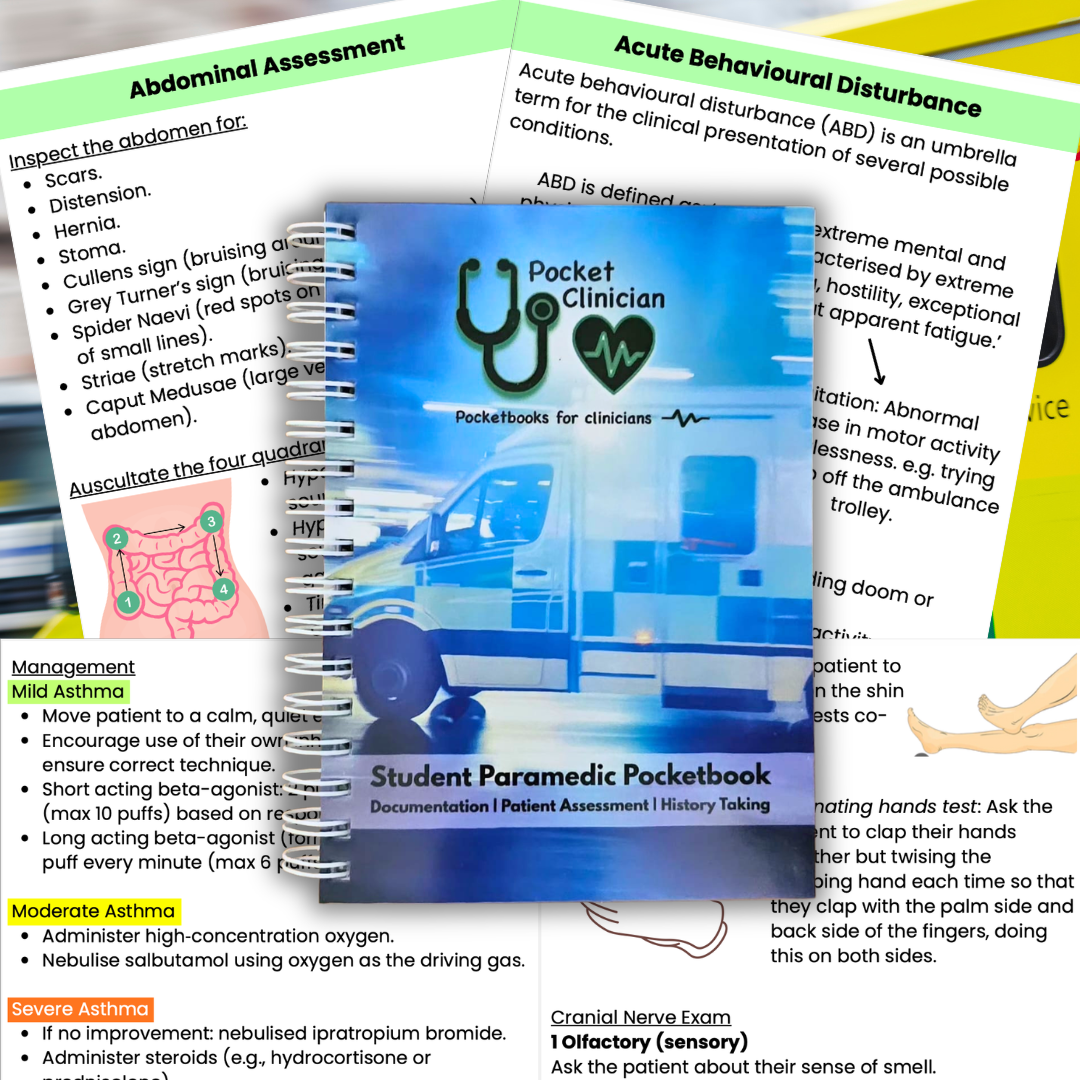
The student paramedic pocketbook provides all the red flags for many commonly seen pre-hospital conditions, as well as supporting you through patient assessment, history taking and documentation.
Confident patient assessment, documentation & handover — in your pocket
Built for student paramedics. Designed for real ambulance practice.
The Student Paramedic Pocketbook is a practical, on-shift reference created to support UK student paramedics and ambulance clinicians with the core skills expected on placement, in OSCEs, and on the road.
This updated and expanded edition includes significantly more content than the previous version, with more in-depth patient assessment, up-to-date clinical information, and clear visual aids — all structured for fast, reliable use under pressure.
At a glance
✔ Updated & expanded edition
✔ Designed for UK ambulance practice
✔ Step-by-step patient assessment guides
✔ Clear documentation & handover structure
✔ Visual aids and checklists
✔ Pocket-sized for placements, OSCEs & shifts
What the Student Paramedic Pocketbook covers
This pocketbook focuses on systematic patient assessment, safe clinical decision-making, and professional documentation — the fundamentals every student paramedic must master.
Core assessment & documentation
Documentation (clear, accurate, defensible)
Primary Survey
Secondary Survey / ROS
Pain Assessment
ASHICE & Clinical Handover
NEWS2
Ten Second Triage
METHANE
Common Abbreviations
Full body system assessments
Cardiovascular Assessment
Respiratory Assessment
Neurological Assessment
Abdominal Assessment
MSK Assessment – Limbs
Structured approaches help you stay systematic, thorough, and confident during patient assessments.
Time-critical & high-risk conditions
Cerebrovascular Accident (Stroke)
Seizure Checklist
Myocardial Infarction
Cardiac Arrest & Traumatic Cardiac Arrest
Sepsis
Anaphylaxis
Asthma
Glycaemic Emergencies
Burns
Obstetric Emergencies
Adrenal Crisis
Acute Behavioural Disturbance
Verification of Death
Designed to support early recognition, appropriate escalation, and safe handover.
Practical ambulance skills
12-Lead ECG Placement
Airway Circuit Set-Up
Cardiac Arrest Checklist
Notes pages for placement learning and reflection
Why choose the Student Paramedic Pocketbook?
Written by clinicians, for clinicians
Focused on what student paramedics are actually assessed on
Clear, concise, and clinically relevant
Designed for confidence under pressure
Supports safe practice, good documentation, and effective handover
Ideal for:
Student Paramedics
Paramedic Science students
Ambulance Clinicians
Newly Qualified Paramedics (NQPs)
OSCE preparation
Ambulance placements
On-shift clinical reference
Built to support you from your first placement to qualification — and beyond.