
Why Some Student Paramedics Struggle on Placement Despite Good Grades
Good grades do not automatically create confident clinicians
One of the most difficult truths in paramedic education is this:
Some students who perform exceptionally well at university still struggle on placement.
And equally:
Some average academic students thrive clinically very quickly.
This often confuses students, mentors, and even educators.
The reason is not intelligence.
It is not laziness.
And it is not that university education is “failing”.
The issue is that academic performance and clinical performance are not assessing exactly the same thing.
University rewards knowledge. Placement rewards application.
At university, students are often rewarded for:
Remembering information
Understanding theory
Performing well in controlled assessments
Revising predictable content
Placement is fundamentally different.
On placement, students must:
Think under pressure
Communicate with unpredictable patients
Prioritise competing information
Tolerate uncertainty
Make decisions without perfect information
These are very different cognitive demands.
📌 Knowing information is not the same as applying it dynamically in real clinical environments.
The problem isn’t knowledge. It’s cognitive overload
Many students who struggle clinically are actually highly knowledgeable.
The difficulty arises because placement introduces:
Noise
Pressure
Interruptions
Uncertainty
Time constraints
Emotional stress
Under these conditions, working memory becomes overloaded.
This is why students often say:
“I knew this at university…”
“My mind just went blank…”
“I can answer it on paper but not on placement…”
This is not lack of ability.
It is the difference between theoretical recall and applied clinical performance.
Clinical reasoning is rarely as linear as university teaching
In educational settings, clinical problems are often presented clearly:
One scenario
One diagnosis
One expected pathway
Real patients are rarely this cooperative.
Patients may:
Present vaguely
Give incomplete histories
Have multiple conditions simultaneously
Appear “well” despite serious illness
Students who rely heavily on memorised structures can therefore struggle when:
Presentations become messy
Answers do not fit expected patterns
The assessment stops feeling predictable
📌 Placement rewards flexible thinking, not rigid recall.
Communication under pressure is a clinical skill
Strong academic students sometimes underestimate how demanding communication becomes in real practice.
On placement, students must:
Build rapport quickly
Adapt language
Gather information efficiently
Communicate while thinking clinically
This is cognitively demanding.
A student may fully understand sepsis academically, but struggle to:
Assess a confused patient
Prioritise information
Communicate findings clearly under pressure
This does not mean the student lacks knowledge.
It means clinical communication is a separate professional skill.
The hidden skill: tolerating uncertainty
One of the biggest transitions into paramedic practice is learning to function without certainty.
University assessments often encourage:
Correct answers
Defined pathways
Predictable marking criteria
Clinical practice is different.
Paramedics frequently work with:
Incomplete information
Evolving presentations
Ambiguous findings
Risk-based decisions
Students who are academically strong sometimes struggle because they are uncomfortable acting without definitive answers.
📌 Safe clinicians do not eliminate uncertainty, they manage it appropriately.
Why confidence can be misleading on placement
Placement can create unhealthy comparison very quickly.
Students often assume:
The loudest student is the most competent
The most confident student is the safest
Hesitation means weakness
In reality:
Some confident students lack insight
Some anxious students are clinically excellent
Some quieter students are processing information deeply
Clinical competence is not always externally visible.
Pattern recognition takes time, and university cannot shortcut it
Experienced clinicians recognise deterioration and risk because they have:
Seen hundreds of patients
Repeated assessments
Reflected on mistakes
Built subconscious comparison patterns
Students do not yet have this exposure.
This means placement initially feels mentally exhausting because:
Every presentation requires deliberate thought.
Over time, patterns begin to form:
The septic patient who “looks wrong”
The chest pain history that feels concerning
The breathless patient who is tiring
This development is normal and unavoidable.
Why some students improve dramatically later
Some students appear average early in training but improve rapidly later.
Why?
Because once:
Clinical exposure increases
Structure becomes automatic
Cognitive load reduces
Their reasoning capacity expands significantly.
This is why early placement performance is not always predictive of future clinical ability.
What actually helps students improve clinically
Students usually progress fastest when they focus on:
Structured patient assessment
Clinical reasoning
Reflective practice
Communication under pressure
Pattern recognition over memorisation
This is why many students benefit from structured clinical resources that focus on:
Assessment flow
Clinical prioritisation
Real-world application
Rather than purely academic recall.
The PocketClinician Student Paramedic Placement Survival Pack was designed specifically around this gap:
Helping students bridge university learning into placement performance
Improving structured thinking under pressure
Supporting safer, calmer assessment approaches
Rather than simply memorising scripts.
Final clinical perspective
Good grades matter.
Knowledge matters.
Academic understanding matters enormously.
But clinical practice also requires:
Adaptability
Communication
Risk recognition
Decision-making under uncertainty
As a student paramedic, struggling on placement does not mean you are failing.
Often, it means:
You are transitioning from theory into practice
You are learning to think clinically
You are developing professional judgement
And that process is far more complex than memorising information for an exam.
That is what makes paramedicine difficult.
And it is also what makes it professional.
Supporting the transition from university to placement
The PocketClinician Student Paramedic Placement Survival Pack was designed specifically to help student paramedics bridge the gap between university learning and real-world placement performance.
The pack focuses on:
Structured patient assessment
Clinical reasoning under pressure
Documentation and handover
ECG interpretation
Leading jobs and communicating confidently on shift
Built for the realities of ambulance placement, not just classroom theory, it’s designed to help students feel calmer, more organised, and more clinically prepared when stepping onto the road.
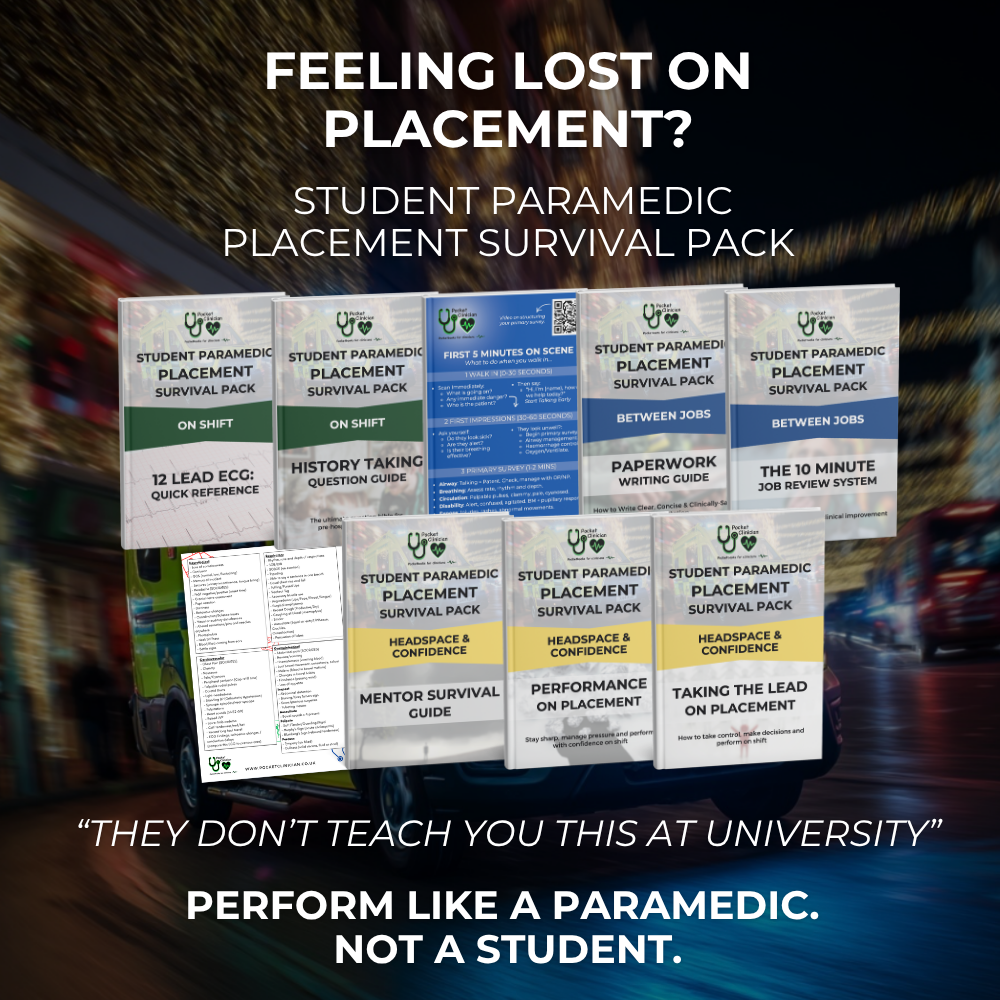
Pre-Order sale | Limited Time Only | Expected shipping est 1st May 2026.
Placement isn’t where you learn theory. It’s where you’re expected to perform.
Starting placement as a student paramedic can feel overwhelming.
You’re expected to assess patients, make decisions and perform under pressure, yet most students feel unsure, overthink everything and go quiet when it matters most.
This isn’t another textbook.
This is your complete placement survival system.
Built specifically for student paramedics and ambulance clinicians, this pack gives you the exact structure, wording and confidence to know what to do on shift.
What This Fixes
Not knowing what to say to patients
Freezing when your mentor says “over to you”
Getting stuck during history taking
Struggling to interpret ECGs
Writing poor or unclear paperwork
Missing opportunities on placement
Feeling behind compared to other students
👉 This pack turns uncertainty into clear, structured action
What’s Inside
ON SHIFT
✔ 12 Lead ECG Quick Reference Guide
Interpret ECGs quickly and confidently on shift
✔ History Taking Question Guide
Over 250 questions across 16 common conditions
✔ First 5 Minutes On Scene Card
Know exactly what to do the moment you walk in
✔ Review of Systems Crib Sheet
Never miss key symptoms again
BETWEEN JOBS
✔ Paperwork Writing Guide
Write clear, concise and clinically safe documentation
✔ The 10 Minute Job Review System
Turn every job into real clinical improvement
HEADSPACE & CONFIDENCE
✔ Mentor Survival Guide
Impress your mentor, ask for opportunities and handle challenges
✔ Performance on Placement
Manage pressure, fatigue and perform consistently
✔ Taking the Lead on Placement
Learn how to step up, make decisions and stay in control, even when you don’t know
Why This Is Different
Most resources teach theory.
This shows you exactly what to do on shift.
Real-world scripts you can actually use
Structured approaches to every job
Practical tools designed for ambulance placements
Built to improve performance from day one
Who This Is For
Student paramedics on placement
Ambulance clinicians in training
Anyone who wants to feel more confident on shift
⚡ The Result ⚡
By using this pack, you will:
✔ Walk into jobs with a clear plan
✔ Communicate confidently with patients and mentors
✔ Make better clinical decisions
✔ Improve after every shift
✔ Stand out on placement
Placement is where you become a clinician.
You can either learn through trial and error…
Or Use a system that shows you exactly how to perform
Don’t Fall Behind on Placement
Get the Student Paramedic Placement Survival Pack today.