
Top 10 Mistakes Student Paramedics Make on Placement (And How to Avoid Them)
Every student paramedic makes mistakes. The good ones learn from them early
Placement is where theory meets reality, and where most student paramedics realise:
“This is a lot harder than I thought.”
That’s not a problem. That’s the point.
Mistakes on placement aren’t a sign you’re failing, they’re a sign you’re learning. The key is recognising which mistakes matter and correcting them early.
This blog breaks down the most common placement mistakes, not to criticise, but to help you become a safer, more confident clinician faster.
1. Treating patient assessment like a script
Students often arrive on placement with memorised structures — and try to follow them word-for-word.
The problem:
Real patients don’t follow scripts
Conversations don’t flow neatly
You lose your place and panic
What to do instead:
Focus on:
Why you’re asking questions
What you’re trying to rule in/out
Keeping a flexible structure
📌 Assessment is a framework, not a performance.
2. Rushing the primary survey
This is one of the most common, and most important mistakes.
Students:
Skip steps
Perform it too quickly
Treat it as a formality
Why it matters:
The primary survey identifies life-threatening problems.
Fix:
Slow down
Say findings out loud
Treat problems as you find them
3. Trying to impress instead of being safe
It’s tempting to:
Use complex terminology
Suggest advanced ideas
“Show what you know”
But mentors aren’t looking for cleverness, they’re looking for safe practice.
Fix:
Stick to clear, logical thinking
Don’t overcomplicate
Prioritise patient safety over sounding impressive
📌 Safe > smart, every time.
4. Not speaking up when unsure
Many students stay quiet because they don’t want to look inexperienced.
In reality:
Silence is riskier than asking
Mentors expect questions
Uncertainty is normal
Fix:
Ask early
Clarify decisions
Share your thinking
5. Overloading history taking
Students often ask:
Every question they’ve ever learned
Regardless of relevance
This leads to:
Long, unfocused assessments
Missed key information
Fix:
Ask:
What am I trying to find out?
What will change my management?
📌 Targeted questions will reduce endless questions.
6. Ignoring reassessment
Students often:
Assess once
Move on
Forget to revisit the patient
Why it matters:
Patients change. Deterioration happens.
Fix:
Recheck observations
Re-evaluate symptoms
Verbalise changes
Reassessment shows clinical awareness.
7. Being falsely reassured by “normal” observations
Normal obs do not always mean a patient is safe.
Students may:
Relax too early
Miss subtle deterioration
Fix:
Always consider:
The overall clinical picture
Patient appearance
Risk factors
📌 Treat the patient, not just the numbers.
8. Poor or vague handovers
A common issue:
Too much information
No clear structure
No clinical impression
Fix:
Focus on:
What’s wrong
How unwell they are
What you’ve done
What you think
Clear handovers = safer care.
9. Weak documentation
Students often:
Overwrite irrelevant details
Miss key reasoning
Fail to justify decisions
Fix:
Ensure your documentation shows:
Assessment findings
Clinical reasoning
Decision-making
📌 If it’s not documented, it didn’t happen.
10. Comparing yourself to other students
This one quietly affects confidence more than anything else.
You’ll see:
Confident students
Fast learners
People who “seem ahead”
What you won’t see:
Their mistakes
Their doubts
Their struggles
Fix:
Focus on your progress
Build solid foundations
Accept that confidence comes later
Final thoughts: mistakes are part of becoming a paramedic
No student finishes placement without mistakes.
The difference is:
Some ignore them
Some learn from them
If you:
Reflect
Ask questions
Stay safe
You will improve quickly.
Want to feel more confident on placement?
PocketClinician resources are designed to support structured assessment, clear documentation, and confident clinical reasoning, helping student paramedics perform better on placement and in OSCEs.
Use tools that reduce uncertainty, not increase it.
The student paramedic bundle will guarantee to aid your patient assessment, history taking, documentation, AND build your ECG confidence for placement.
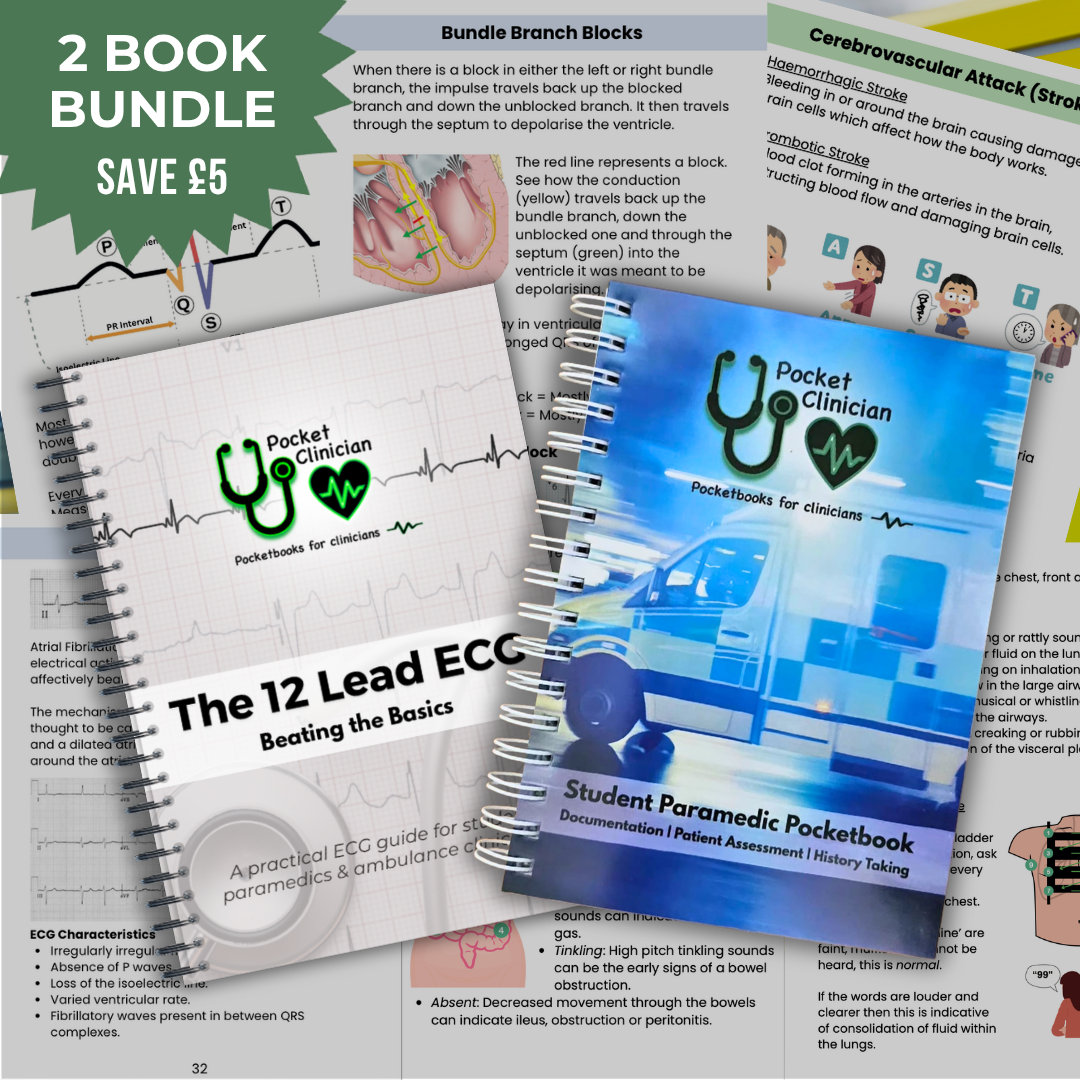
Two essential pocketbooks for confident patient assessment, documentation & 12-lead ECG interpretation
Built for student paramedics. Trusted by ambulance clinicians.
The Student Paramedic Bundle is a practical, on-shift reference designed to support UK student paramedics and ambulance clinicians with the skills that matter most: patient assessment, professional documentation, clinical handover, and ECG interpretation.
This bundle includes two pocket-sized guides that work together to build confidence on placement, in OSCEs, and on the road — without unnecessary theory or overwhelming detail.
At a glance
✔ Updated Student Paramedic Pocketbook (expanded & improved)
✔ 12-Lead ECG pocketbook: Beating the Basics
✔ Designed for UK ambulance practice
✔ Clear layouts, checklists, and visual aids
✔ Ideal for placements, OSCEs, revision & shifts
✔ Suitable for student paramedics, NQPs & ambulance clinicians
The Student Paramedic Pocketbook
UPDATED & EXPANDED EDITION
This upgraded edition contains significantly more content than the original version, with:
More in-depth patient assessment
Up-to-date clinical guidance
Clear pictures and visual aids
Improved structure for real-world use
It’s designed to help you assess patients systematically, document clearly, and hand over safely — core competencies expected of every student paramedic.
Core assessment & documentation
Documentation (clear, accurate, defensible)
Primary Survey
Secondary Survey / ROS
Pain Assessment
ASHICE & Clinical Handover
NEWS2
Ten Second Triage
METHANE
Common Abbreviations
Full body system assessments
Cardiovascular Assessment
Respiratory Assessment
Neurological Assessment
Abdominal Assessment
MSK Assessment – Limbs
Time-critical & high-risk conditions
Cerebrovascular Accident (Stroke)
Seizure Checklist
Myocardial Infarction
Cardiac Arrest & Traumatic Cardiac Arrest
Sepsis
Anaphylaxis
Asthma
Glycaemic Emergencies
Burns
Obstetric Emergencies
Adrenal Crisis
Acute Behavioural Disturbance
Verification of Death
Practical ambulance skills
12-Lead ECG Placement
Airway Circuit Set-Up
Cardiac Arrest Checklist
Notes pages for placement and reflection
Beating the Basics: The 12-Lead ECG Pocketbook
ECG interpretation made simple and clinically relevant
Beating the Basics breaks down 12-lead ECG interpretation into a clear, step-by-step approach that makes sense in real clinical practice.
Perfect for student paramedics, newly qualified paramedics, and ambulance clinicians who want to recognise ECG patterns confidently and communicate them accurately.
ECG fundamentals
ECG Lead Placement
ECG Lead Reference Chart
Cardiac Conduction System
Who Needs an ECG?
Big Squares vs Little Squares
Intervals & Segments
Basic Rhythms
Arrhythmias & conduction disorders
Atrial Fibrillation
Atrial Flutter
Supraventricular Tachycardias (SVT)
PACs & PVCs
1st Degree AV Block
2nd Degree AV Block (Mobitz I & II)
3rd Degree (Complete Heart Block)
Right & Left Bundle Branch Block
Acute coronary syndromes & high-risk ECGs
STEMI (including atypical presentations)
Posterior STEMI
Inferior MI with Right Ventricular Involvement
NSTEMI & High-Risk ACS
Benign Early Repolarisation
Syndromes you must recognise
Wolff-Parkinson-White (WPW)
Brugada Syndrome
Professional practice
Documenting the ECG correctly
Why choose the Student Paramedic Bundle?
Written by clinicians, for clinicians
Focused on UK ambulance service expectations
Clear, concise, and clinically relevant
Designed for confidence under pressure
Supports safe decision-making and patient care
Ideal for:
Student Paramedics
Paramedic Science students
Ambulance Clinicians
Newly Qualified Paramedics (NQPs)
OSCE preparation
Ambulance placements
On-shift clinical reference
Built to support you from your first placement to qualification — and beyond.