
The Student Paramedic Survival Guide: What They Don’t Teach You at University
Becoming a student paramedic is one of the most rewarding routes into healthcare — but let’s be honest, it can also feel overwhelming, confusing, and occasionally soul-destroying.
University prepares you for theory, OSCEs, and guidelines.
What it doesn’t always prepare you for is:
The first time a real patient looks at you for answers
Writing ambulance documentation that suddenly feels very permanent
Feeling like everyone else knows more than you
The quiet fear of thinking: “Am I actually cut out for this?”
If you’ve felt any of that — good. You’re normal.
This guide is written for UK student paramedics who want honest advice, no fluff. Below are a few pointers that make your university journey feel more normal, but most importantly - survivable!
1. Everyone feels clueless on placement (even the “confident” ones)
One of the biggest myths in paramedic education is that other students somehow “get it” quicker than you.
They don’t.
Most student paramedics:
Rehearse assessments in their head constantly
Worry about saying the wrong thing
Feel slow, awkward, or in the way on placement
Confidence on the road doesn’t come from knowing everything — it comes from seeing patterns repeatedly.
Key truth:
Competence develops after discomfort, not before it.
If you’re uncomfortable, your brain is learning.
2. Real patients don’t follow OSCE scripts (and that’s okay)
OSCEs are structured. Patients are not.
In real pre-hospital care:
People interrupt you
They forget their own history
They tell you the least relevant detail first
They change their mind halfway through answering
New student paramedics often panic when their neat OSCE structure collapses on placement.
Instead of memorising scripts, focus on:
Assessment priorities
Clinical reasoning
Knowing why you’re asking questions
This is why many students struggle early — they’ve been taught what to say, not how to think.
(And yes, this is exactly where well-designed pocket guides quietly help — structure without scripting.)
3. Documentation is harder than it looks — and no one tells you why
Ambulance documentation is one of the biggest shocks for student paramedics.
At university, paperwork feels theoretical.
On placement, it suddenly feels:
Legal
Permanent
Slightly terrifying
Most students over-document because they’re scared of missing something. Others under-document because they don’t know what actually matters.
Good paramedic documentation is:
Clear
Clinically relevant
Defensible
Easy for someone else to understand
“Not everything needs writing — but the right things do.”
This is a skill that takes time, repetition, and good frameworks. Struggling here doesn’t mean you’re bad — it means you’re new.
4. ECGs feel impossible… until they don’t
Almost every student paramedic believes everyone else understands ECGs better than they do.
They don’t.
The problem isn’t intelligence — it’s how ECGs are taught.
Many students are overwhelmed by:
Waveform memorisation
Endless criteria
Fear of missing something dangerous
In reality, effective ECG interpretation in pre-hospital care is about:
Pattern recognition
Clinical context
Identifying what actually changes management
When ECGs are broken down logically, they stop feeling scary and start feeling useful.
(This is also why simple, focused ECG resources consistently outperform massive textbooks.)
5. You’re not expected to know everything — you’re expected to be safe
This might be the most important point in this entire article.
As a student paramedic, no one expects you to:
Lead every job
Have instant answers
Be perfect
They do expect you to:
Be honest
Ask questions
Put patient safety first
Reflect and improve
“Silence is riskier than asking.”
Good mentors respect curiosity far more than fake confidence.
6. Comparison will destroy your confidence if you let it
Every cohort has:
The loud one
The confident one
The “seems to know everything” one
What you don’t see:
Their mistakes
Their doubts
Their imposter syndrome
Paramedic education is not a race.
Some students peak early. Others peak later, and often become the better clinicians long-term.
Stay in your lane. Learn deeply. Build solid foundations.
7. Why structure beats memory every time
The students who cope best aren’t the ones who memorise the most — they’re the ones with systems.
Systems help you:
Stay calm under pressure
Avoid missing key steps
Document clearly
Perform better in OSCEs and on placement
This is why structured tools — whether mental frameworks or pocket references — are so valuable early in training. They reduce cognitive load when everything feels new.
Final thoughts: if this feels hard, you’re doing it right
Being a student paramedic is challenging because the job matters.
If you:
Care about doing well
Worry about patients
Reflect on your practice
Then you’re exactly where you should be.
Confidence comes later.
Competence is built quietly.
And one day, you’ll realise you’re no longer pretending — you’re practicing.
Want more support like this?
PocketClinician resources are designed to support learning on placement, reduce overwhelm, and give structure without scripting — exactly where most students struggle.
Use what helps. Ignore what doesn’t. And keep going.
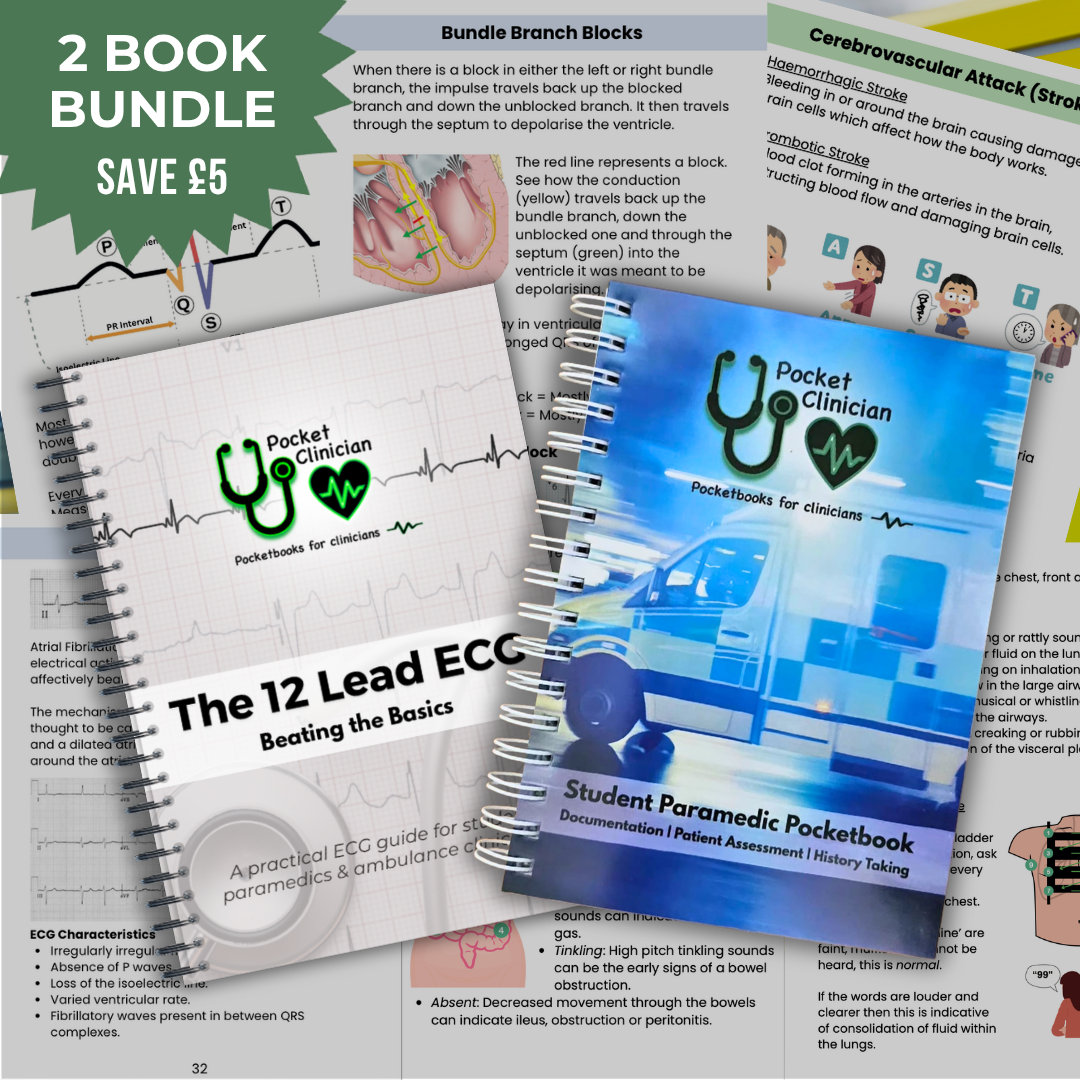
Two essential pocketbooks for confident patient assessment, documentation & 12-lead ECG interpretation
Built for student paramedics. Trusted by ambulance clinicians.
The Student Paramedic Bundle is a practical, on-shift reference designed to support UK student paramedics and ambulance clinicians with the skills that matter most: patient assessment, professional documentation, clinical handover, and ECG interpretation.
This bundle includes two pocket-sized guides that work together to build confidence on placement, in OSCEs, and on the road — without unnecessary theory or overwhelming detail.
At a glance
✔ Updated Student Paramedic Pocketbook (expanded & improved)
✔ 12-Lead ECG pocketbook: Beating the Basics
✔ Designed for UK ambulance practice
✔ Clear layouts, checklists, and visual aids
✔ Ideal for placements, OSCEs, revision & shifts
✔ Suitable for student paramedics, NQPs & ambulance clinicians
The Student Paramedic Pocketbook
UPDATED & EXPANDED EDITION
This upgraded edition contains significantly more content than the original version, with:
More in-depth patient assessment
Up-to-date clinical guidance
Clear pictures and visual aids
Improved structure for real-world use
It’s designed to help you assess patients systematically, document clearly, and hand over safely — core competencies expected of every student paramedic.
Core assessment & documentation
Documentation (clear, accurate, defensible)
Primary Survey
Secondary Survey / ROS
Pain Assessment
ASHICE & Clinical Handover
NEWS2
Ten Second Triage
METHANE
Common Abbreviations
Full body system assessments
Cardiovascular Assessment
Respiratory Assessment
Neurological Assessment
Abdominal Assessment
MSK Assessment – Limbs
Time-critical & high-risk conditions
Cerebrovascular Accident (Stroke)
Seizure Checklist
Myocardial Infarction
Cardiac Arrest & Traumatic Cardiac Arrest
Sepsis
Anaphylaxis
Asthma
Glycaemic Emergencies
Burns
Obstetric Emergencies
Adrenal Crisis
Acute Behavioural Disturbance
Verification of Death
Practical ambulance skills
12-Lead ECG Placement
Airway Circuit Set-Up
Cardiac Arrest Checklist
Notes pages for placement and reflection
Beating the Basics: The 12-Lead ECG Pocketbook
ECG interpretation made simple and clinically relevant
Beating the Basics breaks down 12-lead ECG interpretation into a clear, step-by-step approach that makes sense in real clinical practice.
Perfect for student paramedics, newly qualified paramedics, and ambulance clinicians who want to recognise ECG patterns confidently and communicate them accurately.
ECG fundamentals
ECG Lead Placement
ECG Lead Reference Chart
Cardiac Conduction System
Who Needs an ECG?
Big Squares vs Little Squares
Intervals & Segments
Basic Rhythms
Arrhythmias & conduction disorders
Atrial Fibrillation
Atrial Flutter
Supraventricular Tachycardias (SVT)
PACs & PVCs
1st Degree AV Block
2nd Degree AV Block (Mobitz I & II)
3rd Degree (Complete Heart Block)
Right & Left Bundle Branch Block
Acute coronary syndromes & high-risk ECGs
STEMI (including atypical presentations)
Posterior STEMI
Inferior MI with Right Ventricular Involvement
NSTEMI & High-Risk ACS
Benign Early Repolarisation
Syndromes you must recognise
Wolff-Parkinson-White (WPW)
Brugada Syndrome
Professional practice
Documenting the ECG correctly
Why choose the Student Paramedic Bundle?
Written by clinicians, for clinicians
Focused on UK ambulance service expectations
Clear, concise, and clinically relevant
Designed for confidence under pressure
Supports safe decision-making and patient care
Ideal for:
Student Paramedics
Paramedic Science students
Ambulance Clinicians
Newly Qualified Paramedics (NQPs)
OSCE preparation
Ambulance placements
On-shift clinical reference
Built to support you from your first placement to qualification — and beyond.