
ECGs for Student Paramedics: Why They Feel Hard (And How to Finally Get Them)
If ECGs make your brain freeze, you’re not alone
Almost every student paramedic reaches a point where ECGs feel impossible.
You revise them.
You watch videos.
You memorise criteria.
And yet, when you’re handed a 12-lead on placement or in an OSCE, your confidence evaporates.
This leads to thoughts like:
“I should be better at this by now.”
“Everyone else understands ECGs more than me.”
“What if I miss something dangerous?”
Here’s the truth most ECG teaching misses:
ECGs feel hard because they’re taught in the wrong order.
This guide will show you how to approach ECG interpretation as a student paramedic in a way that actually makes sense in pre-hospital care.
Why traditional ECG teaching overwhelms students
Most ECG resources start with:
Complex electrophysiology
Waveform minutiae
Long lists of criteria
For beginners, this creates:
Cognitive overload
Poor pattern recognition
Fear of missing rare findings
“ECGs are not learned linearly, they’re learned through patterns.”
Clinicians don’t analyse ECGs from first principles every time. They recognise what looks normal, then notice what doesn’t.
The mistake most student paramedics make with ECGs
The biggest error is trying to interpret everything at once.
Students often ask:
What’s the rate?
What’s the rhythm?
What’s the axis?
Is there ischaemia?
All at the same time.
This leads to hesitation, second-guessing, and paralysis.
Good ECG interpretation is layered, not rushed.
A safer way to approach ECGs in pre-hospital care
Instead of asking “What is this ECG?”, ask:
Is this immediately life-threatening?
Is the rhythm broadly normal or abnormal?
Does this ECG match the patient’s presentation?
This mirrors how paramedics actually use ECGs:
To identify time-critical pathology
To guide management
To support decision-making
“ECGs are tools — not puzzles.”
Normal before abnormal: the skill no one emphasises
You cannot spot abnormal ECGs if you don’t deeply understand normal.
Many students rush into STEMI patterns before they can confidently say:
What normal sinus rhythm looks like
What normal intervals are
What normal progression feels like
This creates constant doubt.
Confidence with ECGs starts by being able to say:
“This looks normal, and here’s why.”
Only then do abnormalities stand out.
Why ECGs feel different on placement than in lectures
In lectures:
ECGs are clean
Patients are theoretical
You have unlimited time
On placement:
ECGs are messy
Patients are unwell
Decisions matter
This gap is why many students feel like their ECG knowledge disappears in real life.
The solution isn’t more theory — it’s applied interpretation:
Linking ECG changes to symptoms
Understanding what changes management
Knowing when to escalate
Common ECG traps for student paramedics
1. Overcalling normal variants
Early repolarisation, benign ST changes, and artefact cause huge anxiety.
Not every unusual line equals pathology.
2. Ignoring the patient
An ECG never exists in isolation.
A concerning ECG in a well patient is different from a subtle ECG in a very unwell one.
“Treat the patient, not the paper.”
3. Trying to be too clever
ECGs don’t reward complexity.
Safe practice is about:
Recognising red flags
Acting early
Escalating appropriately
Not naming obscure rhythms.
How to revise ECGs effectively as a student paramedic
High-yield ECG revision includes:
Seeing lots of examples
Grouping rhythms into patterns
Understanding clinical relevance
Practising under time pressure
Memorising endless criteria without context rarely translates to confidence.
This is why concise, clinically focused ECG guides tend to support students better than large textbooks early on.
ECG confidence grows quietly (and then suddenly)
Most paramedics remember the moment ECGs finally “clicked”.
It doesn’t happen overnight.
It happens after:
Repetition
Exposure
Making mistakes safely
Seeing the same patterns again and again
If ECGs feel hard now, it means you’re still in the learning phase — not that you’re failing.
Final thoughts: you don’t need to know everything to be safe
As a student paramedic, your ECG responsibility is not perfection.
It’s:
Recognising danger
Asking for help
Using ECGs to support clinical decisions
Confidence comes later. Safety comes first.
Want ECGs to feel simpler?
PocketClinician ECG resources are designed to help student paramedics recognise patterns, stay structured, and apply ECGs clinically — without overwhelming theory.
Use resources that make learning feel clearer, not heavier.
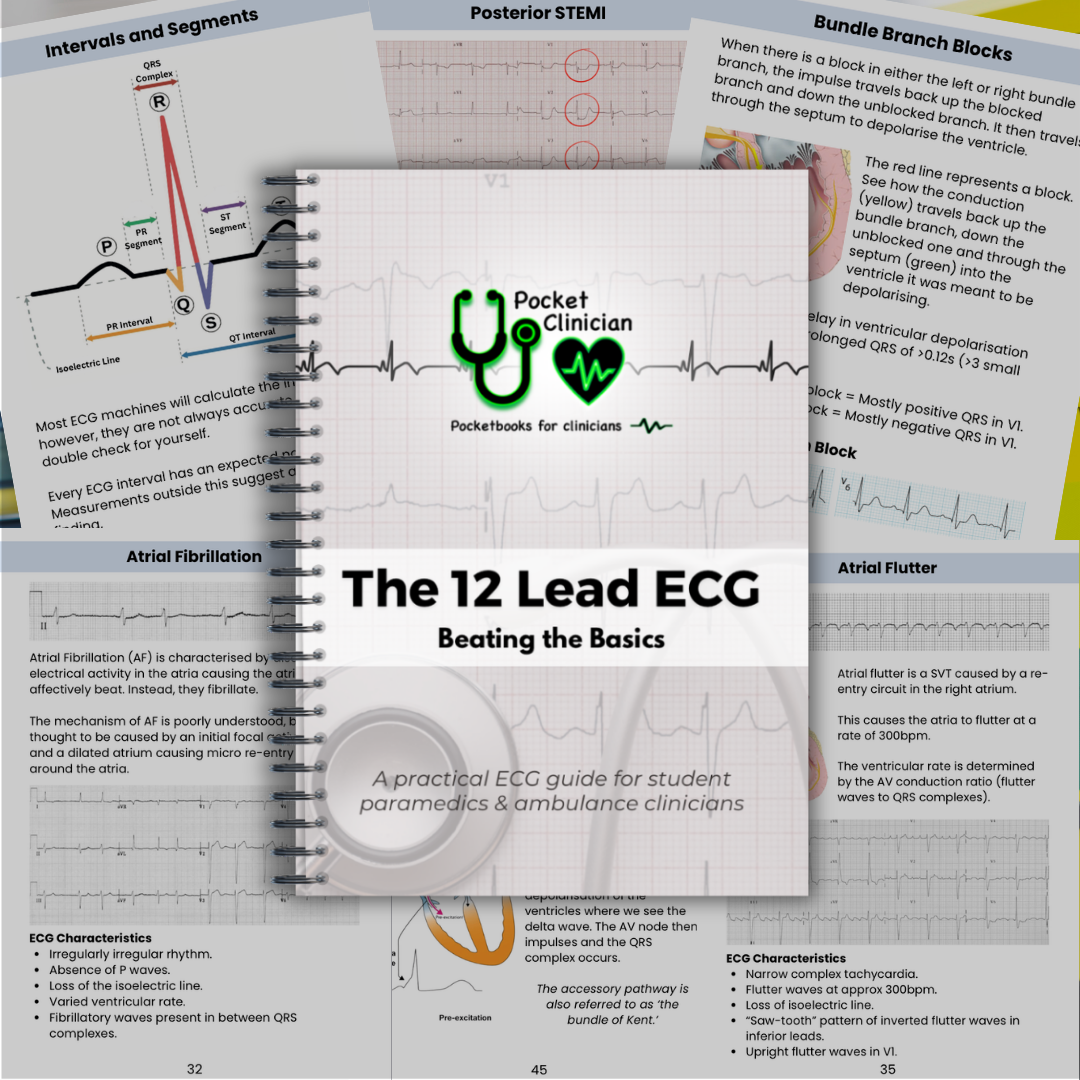
Are you looking for ways to improve your ECG interpretation? Master the ECG with the perfect 12 lead ECG book. This is great for student paramedics who are looking to know more about the ECG.
This book focuses on the interpretation and understanding of the ECG for student paramedics, emergency care assistants, associate ambulance practitioners and paramedics. Key features include identifying specific rhythms, characteristics and management of such rhythms. We focus on everything from basic rhythms to STEMI's and touch on some rarer rhythms such as Wolff-Parkinson White and Brugada syndrome.
Full Contents:
ECG Lead Placement
ECG Lead Reference Chart
Cardiac Conduction System
Who needs an ECG?
Big squares vs Little Squares
The Cardiac Axis
Intervals and Segments
1st Degree AV Block
2nd Degree Mobitz type 1 Block (Wenckebach)
2nd Degree Mobitz Type 2 Block (Hay)
3rd Degree Block (Complete Heart Block)
Bundle Branch Blocks
STEMI
Posterior STEMI
Inferior STEMI
STEMI with atypical presentation
NSTEMI and high risk ACS
Atrial Fibrillation
Atrial Flutter
Supraventricular Tachycardias
Premature Atrial Contractions
Premature Ventricular Contractions
Benign Early Repolarisation
Wolff-Parkinson White (WPW) Syndrome
Brugada Syndrome
Documenting the ECG
Cardiac Arrest Rhythms
Cardiovascular Assessment