
Chest pain is common. Missing something serious is not acceptable
Chest pain is one of the most frequent presentations in pre-hospital care.
For student paramedics, it presents a unique challenge:
Most cases are not life-threatening
Some cases are immediately life-threatening
Early presentations can look deceptively normal
The difficulty is not identifying chest pain, it is identifying risk.
This guide focuses on how to assess chest pain clinically and safely, not just how to ask questions.
What you are really trying to determine
When assessing chest pain, you are not simply diagnosing a cause.
You are answering three critical questions:
Could this be life-threatening?
What level of risk does this patient represent?
What action is required now?
Everything you ask, examine, and interpret should feed into those decisions.
Life-threatening causes you must consider first
Before anything else, chest pain assessment must prioritise time-critical pathology.
These include:
Acute coronary syndromes (STEMI/NSTEMI)
Pulmonary embolism
Aortic dissection
Tension pneumothorax
Students do not need to diagnose each perfectly, but they must:
Consider them early
Look for supporting features
Escalate when risk is present
📌 Assessment is about ruling out danger, not naming the condition.
History taking: identifying risk, not ticking boxes
Chest pain history is often taught using mnemonics, but high-level assessment requires interpretation.
Key elements (and what they actually mean):
Nature of pain
Central, heavy, “crushing” → increases cardiac suspicion
Sharp or pleuritic → consider respiratory causes
Radiation
Arm, jaw, back → classic for cardiac pathology
Associated symptoms
Nausea, sweating, dyspnoea → increase concern for shock
Syncope → high-risk feature
Onset and behaviour
Sudden onset → consider serious pathology
Exertional pain → suggests cardiac origin
📌 The value is not in asking the question, it is in understanding the implication.
Atypical presentations: where students get caught out
Not all serious chest pain looks “textbook”.
High-risk groups often present atypically:
Elderly patients
Diabetic patients
Female patients
They may report:
Breathlessness
Fatigue
Nausea
Mild discomfort rather than pain
📌 A normal-sounding history does not equal a low-risk patient.
The role of the 12-lead ECG
The ECG is a key tool, but must be interpreted in context.
Students often fall into two traps:
Over-relying on a “normal” ECG
Overcalling minor abnormalities
Important points:
A normal ECG does not rule out ACS
Changes may evolve over time
Serial ECGs increase diagnostic value
📌 The ECG supports your assessment — it does not replace it.
Observations: patterns, not snapshots
Observations should always be interpreted in context.
Consider:
Tachycardia (pain, anxiety, or pathology?)
Hypotension (late and concerning sign)
Respiratory changes
Trends matter more than single values.
Red flags in chest pain you must not ignore
Key features that should immediately increase concern:
Ongoing or worsening pain
Haemodynamic instability
Syncope or near-syncope
New neurological symptoms
Severe, sudden onset pain (especially tearing/ripping)
These findings should lower your threshold for:
Rapid transport
Escalation
Continuous monitoring
Clinical decision-making: conveyance vs non-conveyance
Chest pain is rarely a presentation for casual decision-making.
When considering non-conveyance, you must be confident that:
Serious pathology is unlikely
Risk has been assessed thoroughly
The patient understands safety-netting
📌 If uncertainty remains significant, conveyance is usually the safer option.
Common mistakes student paramedics make
From a clinical perspective, frequent issues include:
Being falsely reassured by normal ECG or observations
Failing to consider atypical presentations
Over-focusing on pain description
Not reassessing symptoms
Avoiding escalation due to uncertainty
These are not knowledge gaps, they are clinical reasoning gaps.
Reassessment: essential in chest pain
Chest pain is a dynamic presentation.
Reassess:
Pain severity
ECG changes
Observations
Response to treatment
A patient who was stable can become unstable and vice versa.
Final clinical perspective
Chest pain assessment is not about confidently diagnosing a cause.
It is about:
Identifying risk
Recognising red flags
Making safe, defensible decisions
As a student paramedic, your role is not perfection. It is safe judgement under uncertainty.
That is what protects patients.
Supporting safe chest pain assessment
PocketClinician resources are designed to support structured assessment, ECG interpretation, and clinical reasoning, helping student paramedics manage chest pain presentations safely on placement and in OSCEs.
Use tools that strengthen your decision-making, not just your recall.
Feel more confident assessing chest pain AND master the 12 lead ECG with the student paramedic bundle:
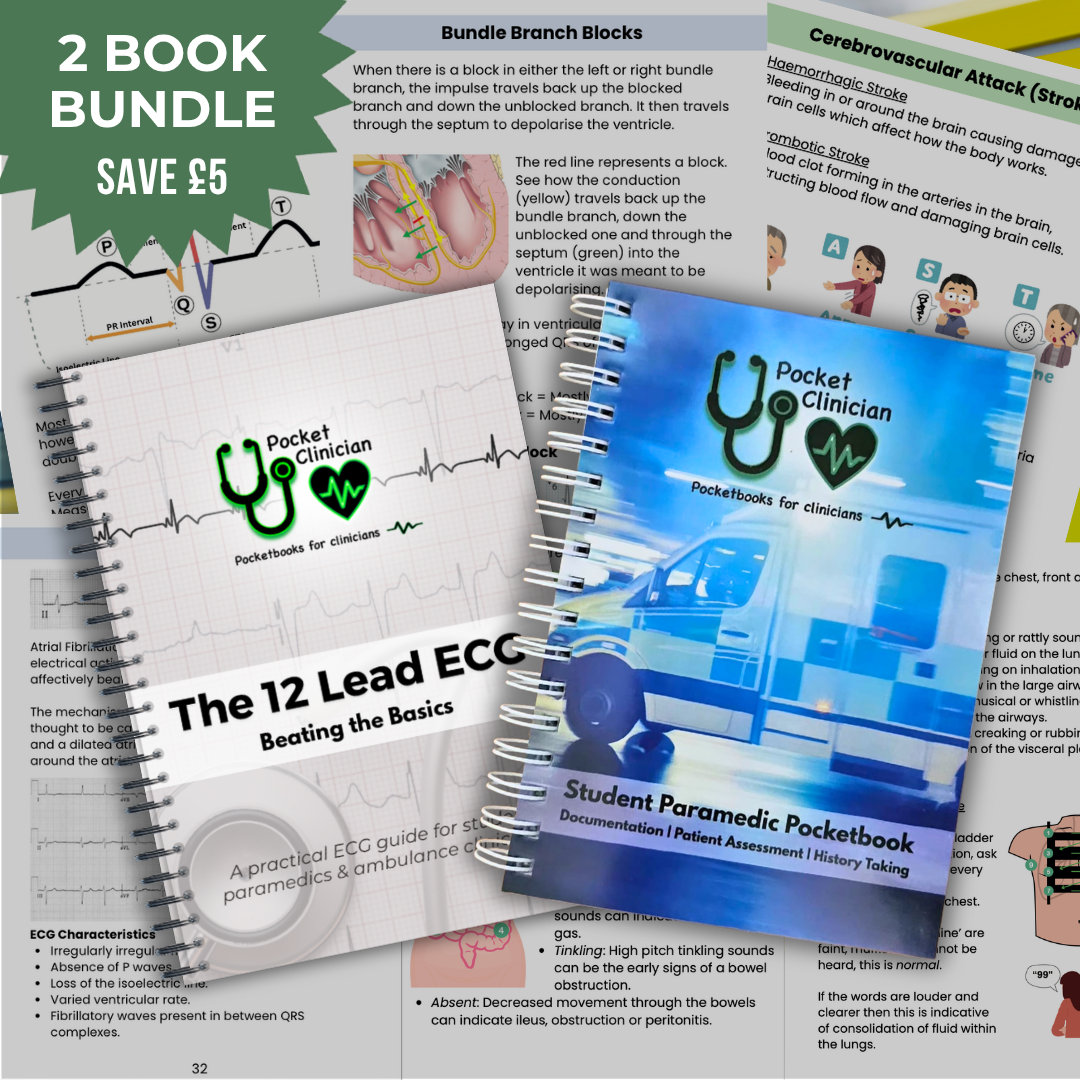
Two essential pocketbooks for confident patient assessment, documentation & 12-lead ECG interpretation
Built for student paramedics. Trusted by ambulance clinicians.
The Student Paramedic Bundle is a practical, on-shift reference designed to support UK student paramedics and ambulance clinicians with the skills that matter most: patient assessment, professional documentation, clinical handover, and ECG interpretation.
This bundle includes two pocket-sized guides that work together to build confidence on placement, in OSCEs, and on the road — without unnecessary theory or overwhelming detail.
At a glance
✔ Updated Student Paramedic Pocketbook (expanded & improved)
✔ 12-Lead ECG pocketbook: Beating the Basics
✔ Designed for UK ambulance practice
✔ Clear layouts, checklists, and visual aids
✔ Ideal for placements, OSCEs, revision & shifts
✔ Suitable for student paramedics, NQPs & ambulance clinicians
The Student Paramedic Pocketbook
UPDATED & EXPANDED EDITION
This upgraded edition contains significantly more content than the original version, with:
More in-depth patient assessment
Up-to-date clinical guidance
Clear pictures and visual aids
Improved structure for real-world use
It’s designed to help you assess patients systematically, document clearly, and hand over safely — core competencies expected of every student paramedic.
Core assessment & documentation
Documentation (clear, accurate, defensible)
Primary Survey
Secondary Survey / ROS
Pain Assessment
ASHICE & Clinical Handover
NEWS2
Ten Second Triage
METHANE
Common Abbreviations
Full body system assessments
Cardiovascular Assessment
Respiratory Assessment
Neurological Assessment
Abdominal Assessment
MSK Assessment – Limbs
Time-critical & high-risk conditions
Cerebrovascular Accident (Stroke)
Seizure Checklist
Myocardial Infarction
Cardiac Arrest & Traumatic Cardiac Arrest
Sepsis
Anaphylaxis
Asthma
Glycaemic Emergencies
Burns
Obstetric Emergencies
Adrenal Crisis
Acute Behavioural Disturbance
Verification of Death
Practical ambulance skills
12-Lead ECG Placement
Airway Circuit Set-Up
Cardiac Arrest Checklist
Notes pages for placement and reflection
Beating the Basics: The 12-Lead ECG Pocketbook
ECG interpretation made simple and clinically relevant
Beating the Basics breaks down 12-lead ECG interpretation into a clear, step-by-step approach that makes sense in real clinical practice.
Perfect for student paramedics, newly qualified paramedics, and ambulance clinicians who want to recognise ECG patterns confidently and communicate them accurately.
ECG fundamentals
ECG Lead Placement
ECG Lead Reference Chart
Cardiac Conduction System
Who Needs an ECG?
Big Squares vs Little Squares
Intervals & Segments
Basic Rhythms
Arrhythmias & conduction disorders
Atrial Fibrillation
Atrial Flutter
Supraventricular Tachycardias (SVT)
PACs & PVCs
1st Degree AV Block
2nd Degree AV Block (Mobitz I & II)
3rd Degree (Complete Heart Block)
Right & Left Bundle Branch Block
Acute coronary syndromes & high-risk ECGs
STEMI (including atypical presentations)
Posterior STEMI
Inferior MI with Right Ventricular Involvement
NSTEMI & High-Risk ACS
Benign Early Repolarisation
Syndromes you must recognise
Wolff-Parkinson-White (WPW)
Brugada Syndrome
Professional practice
Documenting the ECG correctly
Why choose the Student Paramedic Bundle?
Written by clinicians, for clinicians
Focused on UK ambulance service expectations
Clear, concise, and clinically relevant
Designed for confidence under pressure
Supports safe decision-making and patient care
Ideal for:
Student Paramedics
Paramedic Science students
Ambulance Clinicians
Newly Qualified Paramedics (NQPs)
OSCE preparation
Ambulance placements
On-shift clinical reference
Built to support you from your first placement to qualification — and beyond.